Balay Mindanaw works within the context of continuing poverty, underdevelopment and unpeace in Mindanao.
Despite the region’s richness and giftedness, Mindanao remains as the country’s poorest region. Its rural populace alone, despite their closeness to agricultural resources are among the poorest mainly because 70% of those who work in agriculture do not own the land that they till. [expand]
Mindanao remains marginalized economically, politically and culturally. Decisions concerning the lives of Mindanaoans continue to be made by decision-makers in Manila. The unjust center-periphery relationship between Mindanao and the central government persists. Fourteen (14) of the country’s 20 poorest provinces are in Mindanao.
 Balay Mindanaw, lives and works in the upland barangays and tribal communities of Gingoog, Claveria and the municipalities of Eastern Misamis Oriental in Northern Mindanao. Its workers continue to come face to face with the realities of extreme poverty and powerlessness. The vulnerability and marginalization of the basic sectors living within these barangays are basically caused by the lack of access and control over basic economic, social, political and legal resources. This situation is at its starkest in the indigenous communities.
The Indigenous Peoples – IPs – or Lumad, as they are known, remain the least involved or consulted group of all. This makes their opportunities for participation in the development of themselves and their lands increasingly difficult. Economic inequity and political disparity remain the biggest obstacles to the quest for genuine development and lasting peace in Mindanao. The Indigenous Peoples and the Moros continue to be under constant threat of further dislocation and marginalization as their ancestral lands have become targets of large agri-business and industrialist interests
The temporary cessation of hostilities brought about by the peace agreement with MNLF and attempts at peace negotiations with MILF and CPP-NPA-NDF continue to be shattered by the outbreak of violence in various communities. Terror continues to reign in many parts of the region. Hunger and despair continue to creep especially in the Moro and tribal communities and evacuation centers. After a brief lull, communist insurgency has again resurfaced with escalating incidence of violence especially in the hinterlands of Northern, Northeastern and Southern Mindanao. This may well prove that lasting peace can never be attained unless inequity and underdevelopment are first addressed.
Against this backdrop, some small victories are being won and breakthroughs are being made by the peoples and communities.
Empowerment and Democratic Participation of Peoples and Communities
There is a growing informal social movement among NGOs, LGU executives and professional groups that believes in and works towards empowerment and sustainable development of communities with the Barangay as the locus and focus of their initiatives. Workable models for institutionalizing democratic participation of peoples and communities in local development planning have been developed and are now in the process of being replicated in more areas.
Some LGUs – such as Claveria, Gingoog City and the eastern municipalities of Misamis Oriental, Loreto in Surigao del Norte and Hagonoy, Kiblawan and Matanao in Davao del Sur- have already reorganized and strengthened their development councils; drawn up their community profiles using Participatory Rural Appraisal – PRA; formulated their own development plans; developed the relevant projects; mobilised internal and external resources; and most are already implementing some of the projects that they have developed. In these LGUs, civil society participation is noticeably strong and vibrant.
Peace-Building
Local initiatives in peace-building by local communities have not stopped amidst the general condition of unpeace and insecurity. Islamic and Christian religious leaders continue to promote and work hard for continuing dialogue of faiths and lives. Peace advocacy movements like the Mindanao Peace Advocates (MPAC), Mindanao Peaceweavers and Kusog Mindanaw continue to provide avenues for dialogue and collaborative efforts among the various sectors in Mindanao.
And there is this GRP – RPM-M Peace Process that is evolving into an alternative approach to formal peace negotiations. The process that is being pursued in this peace talks does not involve complex political negotiations. Rather, a local peace and development agenda that will have an immediate impact on the ground will be formulated by the communities and tribes of Mindanao. As part of this peace process, a series of Barangay (village) and community-based consultations in areas where the RPM-M has presence are being conducted to determine community problems as well as to identify the projects that can be udertaken as a response to these problems. The projects are expected to be mainstreamed and incorporated in all the levels of local development planning. Equity issues such as land ownership are also expected to be identified and resolved.
Work Done to Date
In Community-Based Work:
BMFI has developed a workable model for institutionalizing people’s democratic participation in formulating local peace and development agendas, and now is in the process of replicating this in the 24 barangays of Claveria, 26 upland barangays of Gingoog, 30 barangays in MISORET, 10 barangays in Davao del Sur and 44 barangays of Iligan City. Basically, the intervention focuses on the reorganization and strengthening of the barangay development councils (BDCs) and tribal councils, the conduct of participatory data gathering through PRA, the formulation of the barangay development plans (BDPs), enterprise and project development, and the mobilization of internal and external resources. To ensure that the gains are sustained and mainstreamed, BMFI now also sits as regular member of the various barangay, municipal/city, provincial and regional development councils.
In Peace-Building:
One major breakthrough in BMFI’s peace-building work has been its key involvement in the peace process between the Government of the Republic of the Philippines (GRP) and the Mindanao-based revolutionary group Rebolusyonaryong Partido ng Manggagawa sa Mindanao (RPM-M) or the Revolutionary Workers’ Party of Mindanao. BMFI acts as the third party mediator and Independent Secretariat of the GRP – RPM-M Peace Process.
This Other Peace Process is proving this Other Paradigm right: Empowered and sustainable communities are the real foundation of lasting peace. The process itself (and not the process’ end) will already allow these communities to win small victories, and build peace by themselves. The final resolution is important but communities need not wait for this. Building peace is here and now.
Our experience in the GRP- RPM-M Peace Process has taught us one important lesson: Peace is not only the journey’s end. More importantly, peace is a way of journeying. Peace is not only the resolution of strife but a way of striving.
In Networking, Coalition-Building and Advocacy:
Balay Mindanaw has also attained some modest gains in coalition-building and development advocacy work as it continues to play key leadership roles and secretariat functions in major Mindanao-wide formations and networks like Kusog Mindanaw, Mindanao Congress of Development NGOs (MINCON), and Mindanao Peace Advocates Conference (MPAC), among others. BMFI also helped catalyze what has become a major campaign in agrarian reform – the MAPALAD Campaign.
BMFI also sits in various government-initiated bodies like the Mindanao Development Council (MEDCO), Mindanao Task Force on Poverty Alleviation (MTFPA), Regional Development Council (RDC) of Northern Mindanao and the various municipal and barangay development councils.
BMFI is also Co-Chair of the Provincial Peace and Order Council of Misamis Oriental.[/expand]
BMFI’s Peace-Building Program
Peace-Building and Development Work in Mindanaw: Helping Build Empowered Sustainable Communities. Helping Build Peace in Mindanaw.[expand]
BMFI’s Peace-Building Program
By Kaloy Manlupig
(Uploaded 27 April 2006)
Peace-Building and Development Work in Mindanaw: Helping Build Empowered Sustainable Communities. Helping Build Peace in Mindanaw.
Goals and Objectives
Balay Mindanaw’s Peace-Building Program aims to contribute the attainment of just and lasting peace in Mindanaw by:
- Helping build empowered sustainable and peaceful communities through comprehensive community-based peace-building initiatives;
- Helping build a strong and stable peace constituency and a social movement of peace-builders through a comprehensive peace education and institution-building program; and
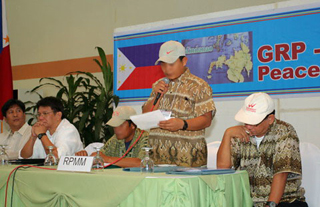 Helping find a final resolution to the Mindanao conflict by acting as mediator and Independent Secretariat to the Peace Process between the Government of the Republic of the Philippines (GRP) and the Rebolusyonaryong Partido ng Manggagawa sa Mindanao (RPM-M).
Since 2005, BMFI has been implementing its Peace-Building Program entitled Helping Build Peace in Mindanao through the following program components:
Program Component One: Community-Based Peace-Building
The barangay (Philippine village) is the key locus and focus of BMFI’s area-based peace-building and development work.
BMFI’s Area-Based Operations Team (ABOT) will continue to live and work fulltime in the 80 barangays that have been identified as BMFI focus-barangays. In these barangays, BMFI’s intervention is at its fullest. This is also seen as the important anchor to keep BMFI “grounded” and rooted as it pursues its other multi-level involvement in peace-building and development work.
Within the next two years, it is projected that BMFI will be able to fully integrate a community-based peace-building component into its sustainable integrated area development program.
Already, all the twenty (20) community organizers of BMFI who are called Sustainable Integrated Area Development Organizers (SIADOs, also pronounced “shadows”) and 25 community leaders and barangay (village) government officials have undergone a four-week Comprehensive Peace-Building Course called OP KORS (Operation Peace Course) held from February to May 2005 in partnership with the Catholic Relief Services (CRS) and Konrad Adenauer Stiftung (KAS).
The last week of the four-week course was devoted to formulating the various community-based peace-building plans of the new peace-builders.
BMFI’s barangay-based and barangay-level peace-building work focuses on the following:
Identifying and training indigenous local leaders and forming them into community-based peace-builders who will take the lead in developing alternative conflict transformation mechanisms;
Incorporating peace-building framework in pursuing democratic local governance work especially through facilitating the strengthening of local people’s organizations and cooperatives, the barangay development councils (BDCs), the conduct of PRAs, the formulation of barangay development plans (BDPs), enterprise development, internal and external resource mobilization and indigenous technology development;
Helping improve people’s access to justice through institution-building and capability-building interventions
At the end of two years, the following shall have been achieved:
- At least one local leader per barangay in sixty (60) barangays trained and actively functioning as community-based peace-builder
- At least sixty (60) community-based alternative conflict transformation committees/teams formed and functioning
- Community-based M&E system installed in each of the sixty (60) barangays
- Sixty (60) barangay-based para-legal and access-to-justice teams formed and functional
Projected impact on the communities:
- Local conflicts resolved at the local level
- Justice issues surfaced, understood and resolved
- Greater and more institutionalized participation in local governance
- Improved land tenure security
- At least 50% of the legal issues/conflicts resolved at the barangay level
Program Component Two: Peace Education and Peace Constituency- Building
A key part of Balay Mindanaw’s new strategy on peace-building is Peace Education as it expects to form a core pool of trained and committed NGO peace workers and grassroots and local government leaders able to work on community-based peace-building and as support team for the Peace Process.
We envision to put in place a team of peace-building cadres in the partner-barangays of Balay Mindanaw.
These trained peace practitioners are expected to be the start of a social movement that will integrate the work for empowerment, development and peace as key to solving Mindanao’s marginalization, underdevelopment and unpeace.
A Comprehensive Course for Peacebuilders in Mindanaw consisting of at least four modules including a seven-day actual work in the various peace zones in Mindanao will be run at least twice a year for two years. This course is a follow up to the 7-day course conducted during the last quarter of 2004 and the four-week course conducted from February to May 2005 in partnership with CRS.
In each course, there will be two simultaneous classes to be run: one for the NGO development workers and peace-builders; and another course for local government officials, barangay captains, paralegals and key local people’s organizations and community leaders.
The Course objectives are:
- Increase awareness on Peace-Building
- Develop/enhance skills in understanding conflict (analysis) and peace-building interventions
- Deepen personal orientation and commitment of peace practitioners
- Formulate Peacebuilding Strategies and Plans
- Facilitate/Initiate the formation of core/pool of peace practitioners
Component Indicators:
After two (2) courses:
50 NGO workers and 50 local leaders trained and functioning as peace-builders
community-based peace-building programs formulated and implemented
CRS will be requested to continue providing the resource persons and facilitators to augment the present BMFI team.
Program Component Three: GRP – RPM-M Peace Process
Framework for the Peace Process:
Empowered and sustainable communities are the real foundation of lasting peace. The process itself (and not the process’ end) will already allow these communities to win small victories, and build peace by and for themselves. The final resolution is important but communities need not wait for this. Building peace is here and now.
Over-All Objectives:
Final resolution to the conflict through a formal peace agreement between GRP and RPM-M; and
Empowered, sustainable and peaceful barangays, communities and tribes able to freely analyze their situation, appreciate their resources, identify their needs, formulate and implement their own plans, and living in harmony with history, culture and nature.
Specific Project Objectives:
The formulation of conflict profile/mapping specifically of the barangay, consolidated sectoral issues with stress on cases of conflicts as well as issues on the marginalization of the tribal groups, and identified priority projects thru the conduct of local consultations in at least twenty barangays in Mindanao.
Implementation of priority development projects in the barangays covered by the local consultations.
Pursue the formal talks leading to a formal peace agreement.
Indicators for Objectives:
Objective 1:
- At least 200 local consultations conducted
- At least 200 consultation documentation
- At least 200 peace and development agendas formulated
- At least 500 proposals for the priority projects developed
Objective 2:
- At least 100 livelihood projects implemented
- At least 100 other community projects implemented
Objective 3:
- Peace agreement signed
Among the most important component of this proposal is the establishment of the Community Peace and Development Support Fund of P100,000.00 per barangay or a total of P1,000,000.00 for ten barangays. Something should immediately happen after each consultation especially in terms of priority projects identified during the consultations. However, it would take sometime to mobilize sufficient resources especially coming from the government. The P100,000.00 allocated for each barangay is expected to ensure that something actually happens in the community after the consultation. This amount would be enough to support small rural infrastructure, livelihood, and other small development projects. This is necessary to help these communities experience the “small victories” needed to inspire them to continue pursuing the path of and to peace.
The priority projects are already identified by the communities through local consultations using participatory technologies.
Target Groups
Component One of BMFI’s Peace-Building Program targets the eighty (80) poorest rural upland barangays (villages) in Claveria, Gingoog and the Misamis Oriental Eastern Towns (MISORET) where BMFI is currently doing community-based work.
Component Two of this Program targets the local community leaders, the elected barangay officials, and the professional NGO workers by training and forming them into peace-builders who will form the core of the new social movement of community-based peace-builders in Northern Mindanao.
Component Three of this Program targets the two principals in the three-decade old conflict between the Government and the revolutionary groups by mediating in the Peace Process that hopefully could lead into a final resolution. This Component will also target the poorest and most marginalized barangays and tribal villages where local consultations will be conducted as integral part of the Peace Process.
Other Actors
This Peace-Building Program is viewed by BMFI as its modest contribution to the bigger and wider pursuit of peace of the various stakeholders at various levels:
The Communities, Villages and Tribes: These are most major stakeholders in the quest for peace. BMFI’s interventions will be heavily influenced and tempered by the local realities, local initiatives and local knowledge. Thus, BMFI’s work is seen mainly as a humble effort to supplement and complement the efforts of the key stakeholders on the ground. This Program will be firmly rooted in the partner barangays and tribes. The barangay development councils, the tribal councils and the various sectoral and geographic organizations participating in these participatory mechanisms are considered as key actors.
The Civil Society: This Program is also viewed by BMFI as its contribution to the broader efforts of the other civil society organizations and networks. Among these networks are the Balay Mindanaw Group of NGOs (BMG), Mindanao Congress of Development NGOs and NGIs (MINCON), Mindanao Coalition of Development NGO Networks (MINCODE), Kusog Mindanaw, and Mindanao Peace Advocates Conference (MPAC). BMFI holds key leadership roles in all these networks and coalitions.
The Church: This Program is also seen as an effort to complement the various initiatives of the local churches especially in the areas of justice, peace and integrity of creation. This is also seen as the anchor peace program of the CABUSTAM cluster of PMP.
The Government (Local and National): Governance is more than the action of government. It is the interaction of government agencies and officials with the corporate sector, civil society organizations, churches, and political parties in the adoption of policies, setting of priorities, allocation of resources, selection of officials, and implementation/non-implementation of decisions. Thus, government is viewed as a key stakeholder in the quest for equity, development and peace. BMFI will continue to work in principled partnership with the local government units, the development councils, the Government Panels in the Peace Processes, the Office of the Presidential Adviser on the Peace Process (OPAPP) and the other national government agencies.
The Resource Partners: BMFI has been blessed by the continued trust and support from its resource partners. These partnerships will be pursued and nurtured in the spirit of mutual respect, transparency and accountability. Among the key resource partners of BMFI are MISEREOR, CORDAID, CRS, German Development Service, GTZ, Konrad Adenauer Stiftung, Trocaire and Christian Aid.
Future Prospects/Sustainability
The Project is considered as an investment into the future. Its success will largely be measured by its impact on the empowerment of peoples and communities as they continue to strive for authentic development and lasting peace.
Furthermore, one of the key result areas of the over-all BMFI program is to increase the capacities of target communities to initiate their activities and raise their own funds from various sources to supplement their own internally mobilized resources. The program calls for community resource mobilization as a key to sustainability.
The Peace Process is viewed as an opportunity or avenue for peoples, tribes and communities to understand, realize, confront and resolve their own issues and problems of inequity, injustice and poverty. The best guarantee of sustainability are the empowered, sustainable and peaceful barangays, communities and tribes able to freely analyze their situation, appreciate their resources, identify their needs, formulate and implement their own plans, and living in harmony with history, culture and nature. [/expand]
Building Capacity on Conflict Management and Peace Building for the Military
Since 2006, Balay Mindanaw has been engaging the military in the efforts to bring about peace in Mindanao, empowering soldiers with conflict management tools in a series of workshops. [expand]
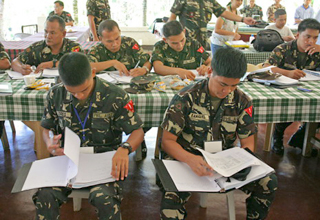 Building Capacity on Conflict Management and Peace Building for the Military
By Ariel C Hernandez and Belle Garcia Hernandez
(Uploaded 9 March 2010
I. The Mindanao Context
Mindanao, the “land of promise,” has long been known for conflict and violence from colonization up to the present. The people of Mindanao, most especially the indigenous peoples and the Moros, have been marginalized by the colonizers who came one after the other and further aggravated by resistance as well as revolt that arose across the centuries (Rodil, 2003). Though the political and administrative structures were gradually established later and became more stable after the Second World War, protests continued, especially in Mindanao, because of the growing dislocation, deprivation, landlessness and further marginalization of Moros and indigenous peoples. Though with little success, armed uprising went on even when the Philippines became independent in 1946. Since then, Mindanao has been a war zone characterized by the armed clashes between Moro bands and government forces (Gaspar, Lapad and Maravillas, 2002).
When President Marcos came into power, he took this Muslim rebellion as a reason to legitimize his declaration of Martial Law in 1972, which has resulted in enormous violence and abuses because of the power bestowed on the military. Victims were not just the Moros and the Lumads but also the Christians as well. These have strengthened the armed struggle against the government, which is still raging up to now. And the Moro provinces are among the country’s poorest (Llanto, 2008). The Moro people, including the indigenous communities, continue to be threatened by dislocation, abuses and marginalization because of armed conflict as well as land disputes or tenurial security issues resulting in food insecurity (Rodil, 2003). Violations of human rights largely happened when then President Marcos declared Martial Law in 1972 and started to inflict authoritarian rule.
The Armed Forces of the Philippines (AFP) and the Moro National Liberation Front (MNLF) at that time fought each other strongly over the provinces of Mindanao. This war continued to give Marcos the authority of a “one-man rule” even with the growing facts of colossal human rights violations (Gaspar, Lapad and Maravillas, 2002).
The Mindanao conflict between the government and the insurgents was aggravated by the power of the succeeding civilian leadership, during their terms, in declaring “total war policy” by then Presidents Aquino and Ramos in 1988 and 1992, respectively, and the “all-out-war” by Estrada in 2000. President Arroyo’s silent war against the communist insurgents since Estrada was ousted in 2001 was formalized as “Oplan Tugis” in 2006 for the AFP with the target to eliminate the communist insurgency in the Philippines by 2010 (Valdez, 2008).
With the ongoing conflict and violence in Mindanao for almost four decades now, the AFP has made its official command to eliminate or neutralize the so-called “enemies of the state” (Calolo, 2006). Even with the civilian presidents who succeeded Marcos who claimed to have restored democracy after the fall of the dictatorship, their policies aggravated and supported the continuing internal war. The former Army chief, Lt. Gen. Romulo Yap, has related his assessment, in his very recent presentation during the Strategic Studies Group (SSG) of the National Defense College of the Philippines (NDCP), that the government still fall short to win a victory over the insurgency, despite the growing number of body counts and firearms recovered (Juntereal, 2008).
This military institution has always been projecting itself as a war machine. In Mindanao alone, the Philippine Army has 4 infantry divisions, consisting of 46 battalions composed of 640 officers, 22,072 enlisted personnel and 32,593 armed volunteers of the Civilian Armed Forces Geographic Unit (CAFGU). They too are expected to maintain peace and order, engage in war yet most of the time not trying to solve the conflict, but rather creating more conflicts more than ever (BMFI, 2006). This is so because of the power they have maintained ever since they were trained to use it: the power of the gun. Soldiers were trained to fight and follow orders. These soldiers are always bound to abide by orders, thus becoming part of the problem. In the current administration, government security forces have been singled out as major violators of human rights (Gloria, 2007). Human Rights watch groups assert that killings (of civilian as well as activists) are being done with the military’s counterinsurgency program dubbed as Operation Plan Bantay Laya (Defend Freedom) that started in 2002 to destroy communist insurgents and Muslim bandits (Castaneda, 2006). This Oplan Bantay Laya, based on a primer developed by the Ecumenical Movement for Justice and Peace (EMJP), is in accordance with the U.S. war on terror and patterned after the U.S. Military strategy that uses heavy weapons against those being considered enemies as terrorist (EMJP, 2006). The Macapagal-Arroyo administration got a $4.6 billion military and economic package in 2004 and a $30 million budget for anti-insurgency military exercises from the US Government (Castaneda, 2006).
In the report of the Commission of Human Rights (CHR) in the Philippines, the Philippine Army was responsible for the most number of cases of human rights abuses: 69% (Tuazon, 2002). Philippine National Police (PNP) and its mobile groups and special action forces got 18% while the hired goons, vigilante groups and other paramilitary forces got 13% (Tuazon, 2002). Furthermore, within 4 years (2001-2005), there was a total of 126, 885 victims whose rights were violated under the human rights law and the International Humanitarian Law (NDFP, 2005). Ninety percent (90%) comes from peasant relations and from Moro areas while 971 are direct victims; 45% of the direct victims were children, while 57% were males; and the military in general has the most number of victims: 86,859 victims (NDFP, 2005).
Table 1
Documented Perpetrators with corresponding number of victims (2001-2005)
|
Perpetrators |
Total Number of Victims |
| Military |
86,859 |
| Army |
33,495 |
| Police + demolition group |
1,412 |
| Police |
859 |
| LGU Personnel |
1,732 |
| Private Security Guards |
1,164 |
| Army-CAFGU |
614 |
| Army-Ranger |
353 |
| MMDA/NHA |
241 |
| Hired Killers |
153 |
| Air Force |
3 |
Source: Alliance for the Advancement of People’s Rights and Children’s Rehabilitation Center (NDFP, 2005)
The United Nations International Children’s Emergency Fund (UNICEF) Children’s Rehab Center has reported 800 cases of human rights violations of children from 2001 to mid 2006. Cases were committed in the areas of military operations (GMA News, 2007). The stories of abuses by the military create general fear, particularly in affected rural communities, of further military abuses and atrocities. Witnesses and family members of victims are scared to cooperate for fear of becoming the next victim (GMA News, 2007).
II. Proponent’s Profile
Balay Mindanaw’s engagement with the military in Mindanao through peace education aims to transform their culture of war into a culture of peace by providing tools in understanding conflict and presenting peaceful approaches as options in conflict management (BMFI, 2006). BMFI believes that the AFP’s approaches have to be challenged and can be transformed towards non-violent and peaceful ways, having their organization, the manpower, the facilities, logistics and discipline. BMFI realized the need to influence the military and strengthen its capacity to make peaceful interventions in the community. These changes will have impact on the on-going formal and local peace process in Mindanao.
BMFI has provided the necessary capacity building interventions to three Infantry Brigades under the 1st, 4th and 6th Infantry Divisions of the Southern Command. BMFI began with the training-workshops which were conducted with the help of resource partners from the academe and institutes. It was in 2006 that BMFI started to explore partnership with then 1st Infantry Division Commanding General Raymundo Ferrer for the trainings of his own officers and paramilitary personnel. Having witnessed the fast growing interest of a number of stakeholders in the military’s involvement towards a culture of peace, both parties have accepted each other’s trust, confidence and capability to make this undertaking possible. The general had seen the effects of the peace trainings in Basilan Province when he was still a brigade commander. When he became a division commander, he and his men (which his superiors approved and believed) were ready to undergo a capability program on conflict management and peace building, in partnership with Balay Mindanaw.
To date, BMFI has facilitated almost 10 batches of peace trainings with the military’s infantry divisions in Mindanao, including brigade and battalion levels. Dubbed as Operation Peace Course or OPKORS, these peace trainings were provided inside their camps and also at the Balay Mindanaw Peace Center which has the modest facilities for effective trainings. Focus was given to the enlisted personnel, non-commissioned officers and paramilitary members of the army called the Citizen’s Armed Forces Geographical Units or CAFGUs. These CAFGUs are based in the barangays and relates closely with the communities living there making sure that peace prevails in the countryside. A training of trainors for the 103rd Brigade and recalls were also be conducted.
To date, Balay Mindanaw finds itself committed not only to the capacity building for conflict management and peace building for the Armed Forces but to contribute meaningfully to the Security Sector Reform of the Philippine Government.
III. Engaging the Armed Forces of the Philippines
a. Recent History
The whole idea of a partnership for security reform started as individual initiatives of past brigade commanders and an NGO which was heavily involved in a peace process in Mindanaw. These were then considered by many as “isolated cases” of a well meaning and sincere effort to contribute to peace efforts in the troubled region of Mindanao. But these “isolated cases” were connected when the whole idea of Bridging Leadership was conceptualized by Prof. Ernesto Garilao of the Asian Institute of Management in 2004 together with Asian Institute of Management (AIM) and Mirant Corporation who was a major player in the power generation industry. Initially, it was Gen. Ben Dolorfino who attended a workshop and was encouraged to apply the concepts and useful tools of the bridging leadership to his Marine Brigade in the early part of the program in 2004. Months later, the first cohort of the Bridging Leadership Fellowship program began with Gen. Raymundo Ferrer and Ariel Hernandez of Balay Mindanaw Foundation, Inc. The two were classmates and became buddies in that program for the two years for 2004-2006. Through formal and informal discussions, the whole idea of connecting military, NGOs and Academe-based peace initiatives and models can be synthesized to build an alternative model that will pursue a reform in the security sector through capacity building on conflict management and peace building.
This concept was then consulted to the leadership of then Southern Command thru Maj. Gen. Gabriel Habacon in 2006, through the different commanders of the three infantry divisions and the marines, the brigade commanders, the NGOs involved in the peace process and peace advocacy, the Academe and even business sectors. This was with blessing and support from the Defense Department through a special order issued by then Sec. Avelino Cruz.
Since then, for almost three years now, with combined resources from those who believed in the meaningful innovation of pursuing peace advocacy even to the security sector, various capacity building activities were done at different levels.
The most recent was the capacity building for the Marine Corps under the leadership of now Commandant Maj. Gen. Ben Dolorfino. The momentum was temporarily suspended when rouge MILF attacked Lanao Norte towns thus triggering a shooting war in this conflict zone of Mindanaw. This was further aggravated by armed encounters in Basilan and Jolo.
b. Newest Development
General Ferrer is the newly installed Commanding General of the Eastern Mindanao Command (EastMinCom) of the Armed Forces of the Philippines. As the Commander, he practically covers 2/3 of the whole Mindanao Region composed of 4th Infantry Division, 6th Infantry Division and 10th Infantry Division, Air Force and Naval forces covering 20 out of the 29 provinces in Mindanao.
Being a visionary and a staunch advocate of conflict management and peace building in the sector he represents, this is the most opportune time to pursue, with passion and with enough influence, the capacity building program piloted and mainstreamed three years ago and now possibly with a strong component of policy advocacy in order to make a significant contribution to the security sector reform of the Armed Forces of the Philippines.
There will be some adjustments in the program as the whole landscape now presents different realities, different players and other issues in the eastern Mindanao command area of operation.
c. Framework on Engaging the AFP
A working document entitled “a framework on engaging the Armed Forces of the Philippines towards a meaningful security sector reform” captures the learning and reflections of the advocates of this program for the past three years. Balay Mindanaw took the initiative to put this into a document not as a final document but as a working paper to guide the discussion with players, supporters and policy makers.
Two Major Components:
1. Capacity Building on Conflict Management and Peace building: Developing Champions for Conflict Management and Peace building
The capacity building will focus on three levels:
For senior officers – this will only be for two days as senior officers, Battalion commanders and brigade commanders cannot be absent in their respective area of responsibility for more than three days.
Junior Officers- this will be for five days covering a full course run by Balay Mindanaw in the last three years with junior officers. Some of the junior officers will also be trained as trainors to do re-echo sessions of the topics in their respective battalions, companies and units.
NCOs – just like the junior officers, the non-commissioned officers who are at the forefront of the action to make or break the peacebuilding efforts in the communities, will also undergo 5-days seminar workshop on conflict management and peacebuilding. A trainors training will also be given to a selected NCOs who will act as multipliers of the capacity building to the Citizen Armed Forces Geographical Units (CAFGUs).
To effectively run the training for the NCOs on conflict management and peacebuilding, the program will invest in training at least 20 personnel from the Division Training Units of the three Army Divisions who runs regular retraining courses for all the NCOs in the respective infantry divisions.
Field Monitoring both by the Division and Area Command personnel will be regularly conducted to assess the effect and impact of the capacity building program both at the personal, unit and community level.
Random semestral recall for chosen personnel will also be conducted to assess the impact of the program at the personal level and to find how to improve the design of the program.
2. Policy Formulation and Advocacy
The objective of the policy advocacy is twofold. First, it seeks to mainstream the conflict and management courses to the formal academic institutions of the Department of National Defense and the Armed Forces, to name a few, the National Defense College of the Philippines (NDCP), General Staff College (GSC), the Philippine Military Academy (PMA). Other schools of the armed forces that are of equal importance for mainstreaming are the Philippine Army Civil Military School, Training and Doctrine Command School. These schools mould the young minds of the future leader of the security sector of this country. By making sure that such conflict management and peacebuilding modules will be incorporated in their curriculum, the program will achieve a lasting impact on the minds and heart of the soon to be policy makers and operational commanders of the security sector.
The 2nd objective of the policy advocacy of this program is admittedly difficult but workable under a favorable environment. This is to attempt to change the doctrine of the basis of promotion for the soldiers. Presently, the basis of promotion is focus on two major areas, that is enemies captured or killed and firearms surrendered or captured. These two indicators are without doubt developed in a war era but were never added nor challenged in a fast changing world like what we have today.
An impact assessment of the capacity building will be conducted to determine the impact of the capacity building program implemented over the last three years. The output of which will be utilized as a learning material for the whole institution of the Armed Forces and will become the basis for policy changes in two important aspects, the basis for promotion and institutionalization of the courses in the various academic and training institutions under the Armed Forces of the Philippines.
This will be done thru policy dialogue among the operations and policy level of the armed forces and the department of defense, roundtable conferences, peace policy writing, publication and media exposure. To ensure ownership and commitment to the reform agenda for the security sector, key stakeholders of peace and development like the LGUs, the leaders of Bishop-Ulama Conference, the Mindanao Business Council,
IV. Program Implementation, Expected Output and Plans
For the next twelve months the following targets shall have been achieved:
1. Capacity Building and Institutional Development:
Champions Development:
At least 150 of brigade, battalion commanders and executive officers undergo a two-day orientation seminar on conflict management and peacebuilding
At least 300 junior officers, company commanders and CMO officers undergo a 4-day conflict management and peacebuilding seminar with clear re-entry plan on their way back to their area of operation
At least 3 trainors training of five days representing three divisions as the multiplier champions of the program composed of 20 junior officers per division
Institutional Development:
Training for DTU
Before, we conduct special trainings for the non-commissioned officers (NCOs) who are frontliners in the field, the program will instead invest in developing the capacity of the Division Training Units whose mandate is to train and re-train soldiers. This will be more cost effective and second it will be a start of the institutionalization process of the program at the division level.
Curriculum Development
A curriculum development will be designed, pilot tested and implemented in the three division training units (DTU) under the EastMinCom. This will only be possible after at least 20 personnel per DTU have undergone a customize orientation and trainors training on conflict management. Such process will ensure that a curriculum that will be mainstreamed in the DTU will also be fully understood, appreciated and can be rightfully re-echoed to soldiers with same level of commitment and passion to their superiors and partners.
Effectively, by mainstreaming the program to the DTUs of the respective infantry divisions, the program will directly influence at least 40 NCOs per month per DTU or about 1200/DTU/Year or a total of 3600 NCO every for 1year.
2. Policy Formulation and Advocacy:
Case Study
For the first three months, the program will invest on Impact Assessment together with chosen case studies and monographs for the previous initiatives to determine the impact of the previous capacity-building program on conflict management and peacebuilding in three levels, namely the personal level, the organizational level and community level.
Round Table Policy Discussion
These workshops will be pursued as they were possibly done in 2007 where key senior and junior officers met some of their top leadership to share, listen and discuss learnings and possible plans which can be done with other key stakeholders. This time the policy discussions will be more substantive as case studies, monographs and an impact assessment will an important input to the discussions along with the key stakeholders.
Policy Paper
A policy writer preferably from the Office of the Strategic Studies or from any Defense establishment will be hired to write the complete policy paper that will be submitted to the Chief of Staff of the Armed Forces and to the Secretary of the National Defense.
The main output is a policy paper to mainstream peace courses in the academic institutions run by the Department of National Defense and the education units of the Armed Forces of the Philippines and a policy paper to insitutionalize a promotion system among the men and women in the Armed Forces involved in peace promotions and creating and strengthening mechanisms local conflict resolution apart from the usual body count and firearms captured or surrendered as the only basis for promotion.
Media Exposure
As a wrap up and synthesis of the program, a forum will be organized and will be aired thru ANC with the presence of DND officials, Division Commanders, Brigade Commanders, NGO partners, BUC Leaders, Mindanao Business Council and the LGU Leaders.[/expand]
Engaging Key Stakeholders and Advancing Capacities and Gains In Conflict Management
and Peace Building towards a Meaningful Security Sector Reform
A. Introduction
Balay Mindanaw, a non-government organization engaged in peacebuilding and development work embarks into a new level of engagement on peacebuilding and conflict management with the security sector.
It now draws in further a multi-stakeholders approach in conflict-affected areas which will include the local government units, line agencies, civil society groups and people’s organizations, not just the military and police. [expand]
Engagements with the Armed Forces
The partnership of Balay Mindanaw with the military has been very helpful in the effective implementation of the capacity building programs which were done with EASTMINCOM during the period of June 2009 to May 2010 and with 103 Infantry Brigade in 2007-2008.
Both engagements opened doors for new learning and experiences among the soldiers trained under the peace course as well as among generals and senior commanders who were able to dialogue among themselves on the issue of considering peacebuilding as an option in military operations. Especially with the last engagement, BMFI and EASTMINCOM advocated at the DND and AFP on the integration of these peacebuilding modules in military trainings. Now, with the Internal Peace and Security Plan of the AFP, peacebuilding trainings and courses are already considered relevant and necessary.
Moreover, the positive impact of the courses into the lives and work of the state actors are very much revealed in the book published, Soldiers for Peace: A Collection of Peacebuilding Stories in Mindanao. These stories formed part of the rationale behind the advocacy of the partnership that such peacebuilding initiatives of soldiers and police in the communities should be recognized and must gain merit.
In a very recent development, new draft AFP Internal Peace and Security Plan (IPSP) which is being regarded as a “Paradigm Shift” has finally emphasized the need for the soldiers to “be trained as peacebuilders, with the capacity for the pre-emption and management of armed violence as well as contribute in the resolution of conflicts.”
Peace champions will continuously be developed among the military and police, with the local government officials and civil society organizations as well. This will be more effective if the capacity building for the peace champions is already adopted by academic institutions. Moreover, a more concrete partnership amongst these key stakeholders, especially at the community level, is imperative in making peace work here in Mindanao NOW!
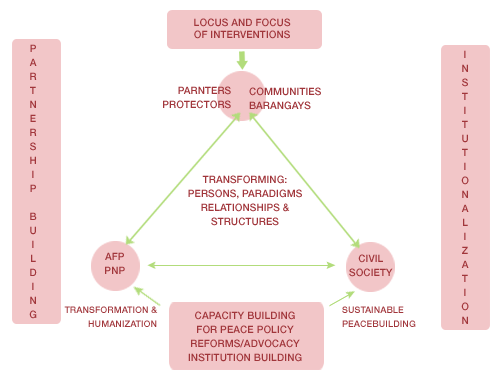
B. Goal and Strategies
With the lessons from peace initiatives with the armed forces, Balay Mindanaw now has enhanced its guiding framework to respond to the multiple efforts in order to further strengthen the SSR agenda.
This new project is entitled, “Engaging Key Stakeholders and Advancing Capacities and Gains in Conflict Management and Peace Building Towards a Meaningful Security Sector Reform.”
The central goal aims at helping transform the security sector into a sector with sustainable peace champions, inclusive of the military, police, local government units and members of the civil society, empowered to build partnerships geared towards community peace, understanding and cooperation.
This will be the main agenda of the Security Sector Reform.
This agenda is specifically supported by four peace policies that the peace champions of SSR wanted to advocate at the local and national governments. More and more peace champions will be developed through continuous peace education and research. At the same time, key agencies of the government will be engaged with for policy advocacy, like the Department of National Defense (DND), Department of the Interior and Local Government (DILG), Office of the Presidential Assistant on the Peace Process (OPAPP) and soon the House of Representatives for possible legislations.
This effort is a continuing program that implements in advance a very important chapter of Peace and Security of the Mindanao 2020.
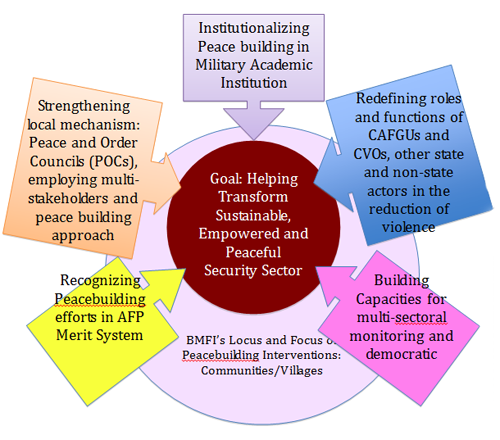
Proposed Peace Policies for the SSR Agenda:
(1) Institutionalizing Peace Education by mainstreaming and integrating the conflict management and peace building modules into the formal academic institutions of the Armed Forces of the Philippines and the Philippine National Police;
(2) Recognizing peace building efforts (a) as a new basis of promotions by adopting into the merit system of the military and police the peaceful, empowered, sustainable communities in their areas of operations and (b) as a centerpoint of creating an award and scholarship-giving body to deserving peace champions and community initiatives that demonstrate best models of transformed societies;
(3) Establishing a local mechanism (a Mindanao Peace and Order Council) that helps address the root cause of existence and increasing number of Private Armed Groups (PAGs) especially in conflict areas of Mindanao; such mechanism should be multi-sectoral and employs various peacebuilding approach thereby transforming them;
(4) Capacitating Civilian Volunteers Organization (CVO), Civilian Auxiliary Forces Geographical Units (CAFGU) that are used as Private Armed Groups by local leaders and/or politicians and non-state actors – for them to make valuable as well as functional contribution to the peace, economic and development aspects of the community, and
(5) Strengthening the capacity of multi-sectors in their role and responsibility as oversight body in the over-all partnership on security sector reform
Guiding Framework and Policy Agenda:
B. Strategy and Over all Impact
By taking the positive gains from the multiple peace initiatives in the past and connecting them to the needs at present, the goal of the new phase of the program will help bring about a meaningful transformation in the security sector, participated by various stakeholders.
The overall impact would be in the development of the government security policies, peace process, relationships among stakeholders as well as in various levels of transformation – personal, family/community, institutional and international community.
By making sure that such conflict management and peacebuilding paradigm will be considered and incorporated in the policies and doctrine of AFP and PNP, the program will help achieve a lasting impact on the minds and heart of the-soon-to-be generals, field commanders, officers and leaders of the security sector as well as policy makers.
Our strategies lie again in (1) building on local capacities for peace and developing champions as resource capital for the security sector reform – now including the LGUs, CSOs in addition to the military/police – in managing local conflicts and building peace through non-violent approaches and (2) advocating such peace efforts of the security sector toward policy formulation, legislation and institutional implementation. In addition to this improved strategies, Balay Mindanaw and its partners in the program will be (3) engaging the international community to enhance the transformation of the security sector and further push for the policy reforms.
C. Program Components:
Component 1 – Community Based Dialogues and Peace Consultations
Several patches of peacebuilding are continuously being worked on even after the previous project. And Balay Mindanaw with EASTMINCOM and WESTMINCOM would like to sustain these efforts of inclusive peace, dialogue and key stakeholdership in violent-affected communities of (1) Maguindanao, (2) North Cotabato, (3) Basilan and (4) Lanao del Norte.
One important mechanism where the LGU, military, police and the civil society groups converge for joint community peacebuilding activities is the PPOC. This component will work towards the functionality of this gov’t-established-structure where people’s participation is vital and encouraged.
Component 2 – Peace Champions Education and Development
Objectives
This component aims to develop more peace champions, not only from the ranks of the military and police but also from the LGUs and other key stakeholders -to further allow them to learn, analyse the community’s context and resources, to better understand their peace and conflict situation in relation to other issues and to expose them to peacebuilding approaches in conflict resolution and management.
This component involves training of soldiers, policemen, local government units and other members of the peace and order councils (line agencies, civil society groups and sectoral reps). Peace courses are offered ranging from basic to training of trainers and thematic sessions to add up in equipping the peace builders at the ground level so that they will be peace champions in community peace and development.
Component 3 -Peace Research and Documentation
As a back-up and support to the policy proposals and recommendation, this component will perform action researches that will give substance and further validate such proposals. Aside from research, creative documentations of lessons learned as well as community peace practices will also be done in support of the policy advocacy. These will be done through participatory processes of discussions and interviews during area visits.
Coupled with the research and documentation are the development of informational materials which will help in pursuing promotions
The first book of the SOLDIERS FOR PEACE was published in 2010, highlighting the 21 peacebuilding transformation stories of soldiers and police. A forum was also organized with Tina Munzon Palma as the anchor woman of the show, taped as live and shown at ANC twice in a row. Both publication and video documentation were disseminated among partners and among the graduates of the peace courses.
Setting up AFP and PNP Peace Scholarship and Awards. This activity will look and study at the best practices where peacebuilding initiatives among the security sector will be examined and must gain recognition. This component hopes to create a Peace Scholarship and Awards Committee who will look into the successful communities and peace champions who are deeply into peacebuilding. They will mainly search and carefully select specific initiatives based on a screening process, which will also be designed during the course of the project. Indicators and criteria will be developed as well as the people behind this committee will be formed between AFP, DND, DILG, Balay Mindanaw, AUSaid and other interested individual advocates of peace building from the academe, civil society, business, media and the government.
Balay Mindanaw is seeing an institutionalized effort that continuously advances, promotes and encourages peacebuilding practices and help facilitate their replication of such models and as well as innovation in more communities in Mindanao, in rest of the Philippines islands and even in Asia and in the World.
Component 4- Policy Advocacy and Lobbying
This newly improved component is to enable the top leadership of the Armed Forces of the Philippines (AFP) and Philippine National Police (PNP), backed up by Department of National Defense (DND) and the Department of the Interior and Local Government (DILG) as well as OPAPP, to adopt the proposed policies and make necessary actions to able their implementations.
In the new draft of the Internal Peace and Security Plan (IPSP) for 2011 to 2016, the AFP is deemed to move towards a “paradigm shift” from a combative, violent and militaristic approach to a more humane, peaceful and developmental in strategies, stating that “..soldiers must be trained as peacebuilders, with the capacity for the pre-emption and management of armed violence as well as contribute in the resolution of conflicts.”
D. Monitoring and Evaluation
To measure the impacts at this level, the inquiry in the RPP will aid in monitoring and evaluation of impacts of the program on “Peace Writ Large.”
It is also from this component where the Reflecting for Peace Practices (RPP) approach, developed by CDA Collaborative Learning Projects, will be studied more and gained knowledge and skills in making peace practices more effective.
The output of which will be utilized as a continuing learning material the military and police institutions, other peace institutions and groups around the globe. This will also good support to the policy changes that we advocate.
The lessons of the RPP will be brought into play especially helping improve the effectiveness of the program. Through application of the RPP learnings, consolidating the gains from the experiences will be continued in a way that will be useful for and increase the value of the impacts of the subsequent peace practices. [/expand]