Background and Rationale:
With a vision of Equity, Development and Peace, Balay Mindanaw began as a development NGO in 1996 (12 years ago) focusing on village-based or tribe-based community work in local governance, promotion of sustainable integrated area development and people’s participation and facilitating resource tenure improvement. In year 2000, it gradually began integrating peace in its community development work with the intent (mission) of helping build empowered, sustainable and peaceful communities in Mindanao. In 2004, it 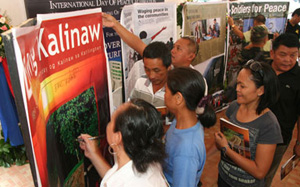 finally developed a peace building program which expressed in concrete terms its new mission of helping build peace in Mindanao. The programs and activities were gradually placed into operation given the various initiatives that were implemented a year before this: peace training, peace process, negotiations, staff development on peace, etc.
Balay Mindanaw established a Peace Center in 2005 as one of its concrete contribution to its community partners. For more than two years now, the peace center has been the venue of many capacity building training, peace conferences and gatherings of peace builders already. At the same time it has become a venue of crucial dialogues, gatherings, negotiations, conversations and conflict resolutions. The peace center has been supporting all peace-related activities especially the information and publication activities of Balay Mindanaw. It hosts these peace education training and activities. It also has a peace room which holds the resource documents about peace and other related issues of peace relevant to research, study and planning.
In 2006, Balay Mindanaw became the host of the first gathering of peace builders from all over Asia. For 5 days, the peace center became the home/hub of the Action Asia network during the Asian Peace Builders’ Forum.
Also, several people, groups and initiatives from some countries have already visited, taught and learned from Balay Mindanaw and the communities it works with. Students, volunteers, educators, security officials, interfaith groups, NGOs and other international peace builders come from Cambodia, Myanmar, East Timor, Japan, Cambodia, South Africa, Indonesia, Kenya and South Korea. They have taken lessons from the field exposure and community dialogues they had with Balay Mindanaw and its partners.
With “ICPeace” (as its acronym reveals), Balay Mindanaw will continue to see that peace can happen and will happen. More and more peace builders are making it happen and will make it happen in this part of the region and in other part of the globe.
ICPeace will conduct peace courses at the regional and international level, pursue asian exchanges and exposures, conduct policy discussion series and advocacy. It will continue to reach out to local, national and international communities through linkaging-networking, online and print publications, workshops and for a.
It will help sustain the momentum of peace builders, local and international alike, to ensure that peace happens here and now.
“It is important to see peace building as a process rather than a goal and not to view it from the perspective of achieving a ‘negative peace’- that is, the ending of armed conflict. Rather it should be understood, from the perspective of a ‘positive’ and sustainable peace that ensures security as well as socio-economic, structural, political and cultural stability, and that reduces the likelihood of relapse into or the continuation of violence” (Chimni, 2003; Lily 2004)
History
The International Center for Peace in Mindanaw (ICPeace in Mindanaw) was established in 2008, evolving from Balay Mindanaw’s peace education program. It was created as one mechanism of Balay Mindanaw while continuing its aim of building a strong peace constituency. ICPeace has continued to develop and implement educational approaches in building peace and conflict transformation.
The strength of the ICPeace lies in the foundation of Balay Mindanaw that is grounded on community-based development and peacebulding work from where unique local knowledge and realities are derived, developed and demonstrated.
The has helped facilitate and manage the development of unique local knowledge, human resources and development realities placing it into the bigger peace building field. Greater opportunities for creative & constructive learning into the realm of peace building and conflict transformation will be provided.
ICPeace has evolved from the Peace Education program of Balay MIndanaw but is now a package of whollistic opportunity that provide venues of learning, education, research, advocacy and the like to provide additional support to peace practitioners of various sectors of society in terms of capacity building.
Major components handled by ICPeace to date are Peace Education and Constituency Building, Peace Research, Peace Advocacy, and Exchange Programs. ICPeace also anchors the programs on Security Sector Partnership ranging from Engaging Partners for Security Sector Reform, Civilian-led Oversight of the Bantay Bayanihan Program and Action Asia Secretariat work.
Some highlights of the each component and programs handled by ICPeace at present.
Peace Education and Constituency-building.
Peace Education and Constituency-building has strengthened its banner course which is the Operation Peace Course (OP Kors!): A Comprehensive Peacebuilding Course for Peacebuilders in Mindanao. OP KOrs! was lauched in 2005 that began with 60 participants to two courses, community leaders and for NGO workers. The first OP KOrs! was conducted for four weeks which included a week long actual conflict analysis and planning in conflict affected areas related to the GRP-RPMM Peace Process.
Since then the OP Kors! has evolved in itself. It is now being customized according to the partners that the course is being provided to. At present, ICPeace promotes the Operation Peace Course (OP Kors!) as a comprehensive peace-building course aimed at developing community leaders, local government officials, staff of non-government organizations, military, youth and other sectors to be effective peacebuilders.
It is a two-week course that is housed at the Balay Mindanaw Peace Center. OP Kors! has been an on-going course at the center for four years now. It ensures better understanding and a good space for people to think, act, learn, and interact amongst participants for a better understanding of the peacebuilding work.
To date there have been 56 batches of OP Kors! with a total of 2500 graduates, 7 batches of Training of Trainers for OP Kors! with 75 graduates and one (1) Peace Work Camp. The graduates are coming from the community partners, village leaders, NGO workers, Local Chief Executives and their respective technical working groups at the municipal level, Police and Military officers and enlisted personnel (Junior to Senior Levels), CAFGUs and Provincial Peace and Order Council members.
The most recent OP Kors! was for the Community Workers and Partners of the Actual Violence Affected Areas and Territories of Balay Mindanaw (Surigao del Sur, 2012 and North Cotabato, 2011), Peacebuilding Seminar for the 1st Class Cadets of the Philippine Military Academy 2012, Provincial Peace and Order Councils for the 6 Provinces in Mindanao, 2011, and State Security and Partners (2011).
For the community leaders, it was mainly participated by barangay officials, youth leaders, religious leaders and volunteers coming from the Municipality of Aleosan, North Cotabato. Aleosan is one of the partner municipality that is considered a violently affected area whereby needing more capacity building focusing on peacebuilding. Most of the participants are active during the conduct of the Local Peace Consultations early part of the 2011. The graduates in this course was able to organize the celebration of the International Day of Peace spearheaded by the Youth in Aleosan in partnership with the local government unit. (July 16-30, 2011)
For the State Security partners, it was mainly participated by officials, with the ranks of Lt to Lt Col from both commands of the Armed Forces of the Philippines and of the Director for the Integrated Police Operations of Western Mindanao. The graduates we representing the mostly from the Civil Military Operations unit from the Battalion, Brigade, and Division levels and command who has made sure that the peace plans are to be integrated into the plans of the units. Some of the units celebrated the International Day of Peace, participated in the Mindanao Week of Peace celebrations, and multi-stakeholders consultations and local peace initiatives of their partner LGUs. There was a plan to conduct a peace course for all the CMO Battalion for the 6th infantry division however, the change of command and key personnel staff affected the plan and the movements. (September 11-17, 2011)
Some insights and experiences of the participants:
“Sa among nakatunan..dako kaayo ang nakahatg na pagsabot..dili lang sa among problema kung dili, ang kaniadto pa gayud nga mao ang nisumpay sa among problema..wala pa gayud insakto nga formula sa kalinaw, apan kita kung naa palang, lihokan gayud nato. Kita karun nga naa dinhi…(Based on the learning process, it gave me a deeper understanding of the problem, that the past has a bearing on the present situation of the problem and there is no exact formula in achieving peace except that we have to work for it. All of us who are attending here …)”
“ako mahadlok gyud ko ug mga boto. Aduna man gud ko experience sa pang bomba, nabiktima gayud ko ug bomba panahon ni Marcos.(Before I am very much afraid of bombing / sound of gun shots, for I have been a bomb victim during the time of Marcos)”
“Nahagit kami karon sa among mga giatubang nga kahimtang….walay yuta, dili makatarunganon nga pag-implementar sa balaod. (We are now challenged on our present situation, we have no land, and that there is an unjust implementation of the law.)
Lawig Kalinaw
In 2008, a homecoming of graduates was organized. The two-day gathering captured the key learnings of the graduates as well as affirmed the need to strengthen the community of peacebuilders. The concrete expression of the community of peacebuilders is what is called “Lawig Kalinaw.”
Lawig Kalinaw is a community of peace builders who believe that peace prevails; to work for it to be possible in Mindanao and around the World. It is a movement of peace practitioners and peace advocates who wants to continue to contribute in building peace. LAWIG KALINAW is the visayan translation of PEACE JOURNEY.
Lawig Kalinaw has been organized in different areas in Misamis Oriental, and now has permanent representatives to the Provincial Peace and Order Council. Plan of actions has been done and the challenge is how this can be sustained. In other areas, Op Kors! graduates’ meet as organized by Balay Mindanaw, and some of the graduates have been tapped as resource persons, facilitators, trainers in different peacebuilding initiatives.
The peacebuilding work is continuing and the peacebuilders are moving and pursuing to share the peace that they have in whatever form.
Hence, there is a need to conscientisize the different learnings, initiatives and strengthen the movement that is already existing towards sustaining the peacebuilding work.
Faculty Review
Faculty review is an on-going process. A core faculty of the Peace Course gathered for two days and to discuss the currents of the peacebuilding courses.
The workshop was among the resource persons facilitators will help in the improvement of the modules and designs of the courses to be provided under this project. It will also improve the curriculum or the program of instructions (POI) for the adoption of the AFP and PNP academic institutions.
The ICPeace that eventually hosts international peace courses, international interns and exposure visits has also improved its being a resource center by developing multi-based media accessible for everyone. This facilitated BM’s intentions of bringing up ground level experiences for reflection by others having the same or relatively similar contexts.
3.1.3 Peace Research and Resource Development
To beef up Balay Mindanaw’s peace building program, particularly its community-based, peace education and advocacy work, Balay Mindanaw embarked in putting up a peace research component in 2008 after its organizational semestral break.
For the past three years, this component has taken the task of writing case studies and consolidating the research papers, producing publications, and developing Balay Mindanaw as a resource center.
Focus Group Discussions
The peace research component has planned to do case studies on the impact of peace courses being conducted by Balay Mindanaw. According to the plan, this component would capture the outcome of the peace course in the military, its effects on the personal, institutional and community levels.
Action Researches and Thesis Papers
There were several action researches made in line with the peacebuilding interventions of Balay Mindanaw. These were made possible when Balay Mindanaw started sending out its managers to the Masteral Program on Applied Conflict Transformation Studies (ACTS) which deals with Action Research during the course in 2006. Since 2008, five action researches were produced (two in 2008; two in 2009; and one in 2010).
One thesis paper was also produced in 2008 when Balay Mindanaw enrolled its staff to the Masteral Program on Peace and Development.
Six papers were produced, went into the process of academic instructions and applied as part of the practical learning. Each of the papers done were presented by the graduates of the programs before a group of around 50 from the academics, civil society groups as well as interested donor agencies.
Creating Space for Dialogue towards transforming Military Policies and Doctrines
Belle Garcia, Peace Research 2008
Masters in Applied Conflict Transformation, Pannasastra University, Phnom Penh, Cambodia
Presented at a Public Conference in Pannasastra University (50 audience), 2008
Local Participation in the GRP-RPMM Peace Process
Charmaine Mae Dagapioso-Baconga, Peace Education
Masters in Applied Conflict Transformation, Pannasastra University, Phnom Penh, Cambodia
Presented at Public Conference in Pannasastra University (50 audience), 2008
Evaluation of BALAOD Mindanaw’s PEACEBUILDING Strategy: Effectiveness of Paralegal Formation Program in Peacebuilding
Rochelle Mordeno, Community- based Peace Building
Masters in Applied Conflict Transformation, Pannasastra University, Phnom Penh, Cambodia
Presented at a Public Conference in Pannasastra University (50 audience), 2009
An Effective Process of Embedding Peace Building Concepts in Party Platform Development
Stanley Uriarte, Networking 2009
Masters in Applied Conflict Transformation, Pannasastra University, Phnom Penh, Cambodia
Presented at a Public Conference in Pannasastra University (50 audience), 2009
Social Enterprise as a Peace building Strategy
Fluerabelle Torres, Community- based Peace Building 2010
Masters in Applied Conflict Transformation, Pannasastra University, Phnom Penh, Cambodia
Presented at a Public Conference in Pannasastra University (50 audience), 2010
Balay Mindanaw Fdn., Inc.
Outcomes of the Peacebuilding Initiatives of the GRP-RPMM in Lanao del Norte
Eileen Ipulan, Independent Secretariat of the GRP- RPMM Peace Process
2008
Masters in Peace and Development, Notre Dame University, Cotabato, Philippines
Presented at Notre Dame University, Cotabato, Philippines
Empowering Communities in Mediating Local Conflicts and Building Peace (Proposed)
Sabrina Garcia, Peace Research (on-going)
(Under Study) Masters in Peace and Reconciliation, De la Salle University, Bacolod City, Philippines
Multi-Sectoral Approach Towards Security Sector Reform: A case in Maguindanao Leonardo Bautista, Peace Education (on-going)
(Under Study) Masters in Applied Conflict Transformation, Pannasastra University, Phnom Penh, Cambodia
Other Short Papers and Presentations
Additional four papers were also written by Balay Mindanaw and presented to certain audiences. One paper was already in the Occasional Monograph, called IseePeace!, while the other papers will be placed soon.
Table 2: Short Papers for Monograph
A Review of the HR, IHL and PB in the AFP/PNP Training Institutions
Juvy Loyola and Rochelle Mordeno, with contract with AUSAID November 2009
Exclusive to Australian Aid- Manila Philippines January 2010
Building Capacity for Peacebuilding and Conflict Transformation and Peacebuilding in the Military: the Balay Mindanaw Experience
Gesibelle Garcia- Hernandez September 2008
Action Asia Peacebuilders’ Forum, Nepal 150 participants October 2008
Action Asia Leaders’ Forum, Malaysia
Balay Mindanaw Fdn., Inc.
The work for Land Rights, Justice, Development and Sustainable Peace In Mindanao
Kaloy Manlupig December 2009
FreEnt Conference, Germany January 2010
Local Participation in the GRP-RPMM Peace Process
Charmaine Mae Dagapioso- Baconga
Published in the Applied Conflict Transformation Studies, Vol.2: Collection of Action Research
Policy Paper
Gail Ilagan
Sec. Norberto Gonzalez, Dept of National Defense Peace Policy Forum February 2010
200 pax
Publications and Productions
Based on the case studies, interviews as well as validation workshops undergone during recall sessions, Balay Mindanaw was able to produce two books: The Soldiers for Peace and the Lawig Kalinaw (Peace Journey). Both books contain the stories and lessons learned, highlighting transformational stories as well as relevant lessons in doing peacebuilding interventions.
Table 3: List of Publications
Soldiers for Peace: A Collection of Peacebuilding Stories
Book, February 2010
Lawig Kalinaw: Stories of Peacebuilding in the
Book, September 2010